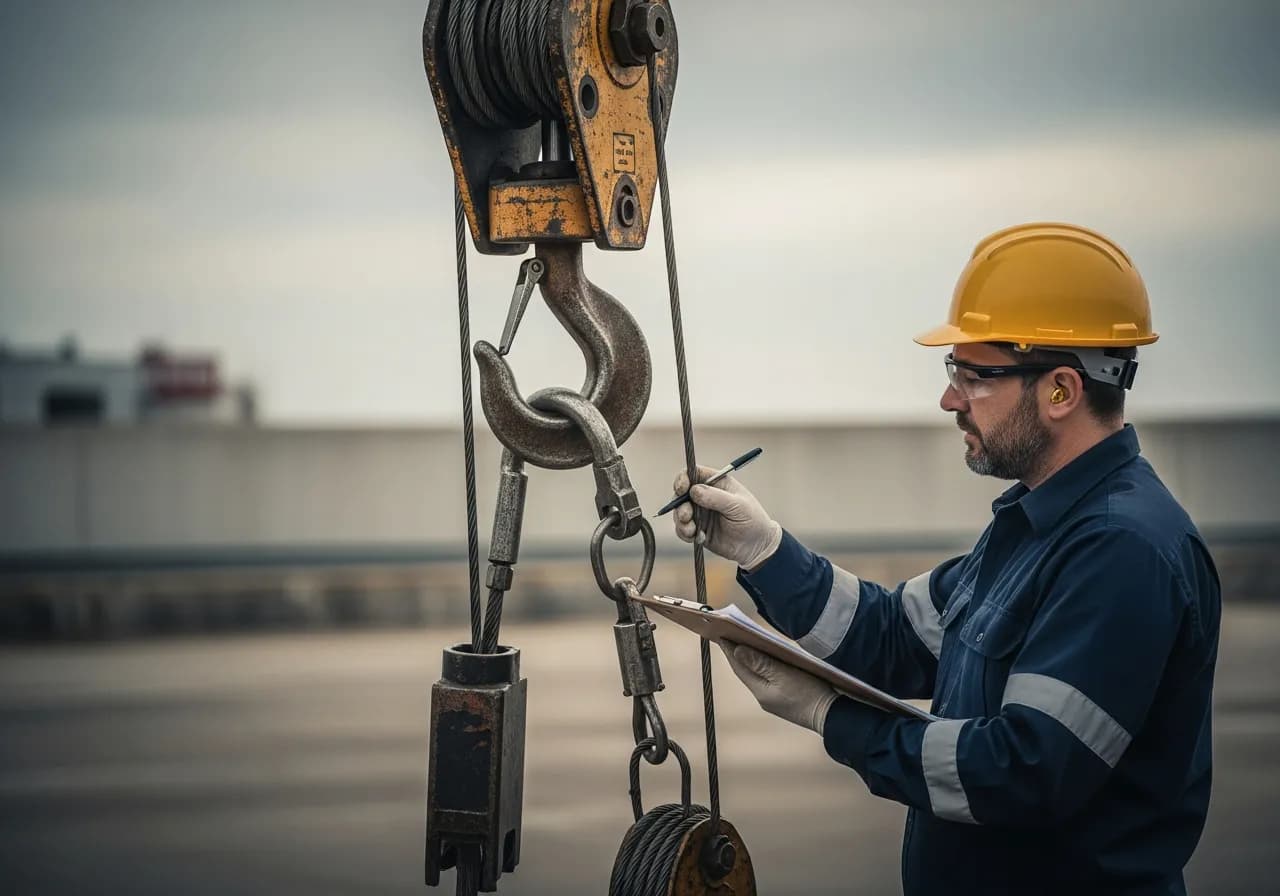
A crane is only as safe as its last inspection, and proving it is as important as performing it. In the United States, crane inspection is set by OSHA — 29 CFR 1910.179 for overhead and gantry cranes in general industry, and 29 CFR 1926 Subpart CC for cranes and derricks in construction — with the ASME B30 standards filling in the technical detail. Get the routine and the records right and inspections become a background task instead of a reason your crane sits idle.
Which rules apply to your crane
Start by placing the crane. A bridge, gantry or jib crane inside a plant or warehouse falls under OSHA 1910.179 and ASME B30.2. A mobile, crawler, tower or boom-truck crane working on a construction project falls under OSHA 1926 Subpart CC, with ASME B30.5 (mobile cranes), B30.3 (tower cranes) and B30.22 (articulating boom cranes) as the technical references. Hooks, slings and below-the-hook devices have their own ASME B30 volumes. If your state runs its own OSHA-approved State Plan — California and Washington are examples — its rules apply and can go further than federal OSHA.
The inspection layers
Compliance is a layered routine, not a single annual event.
- Shift / pre-use inspection — a competent person checks the crane before each shift: controls, brakes, the hook and latch, wire rope, safety devices and any visible damage.
- Frequent inspection — daily to monthly, depending on how hard the crane works, looking more closely at wear that everyday use hides.
- Monthly inspection — for construction cranes, OSHA expects a documented monthly inspection; for overhead cranes, wire rope and hooks need a documented monthly check.
- Periodic inspection — a detailed examination by a qualified person at intervals from one to twelve months, set by duty, environment and age.
- Annual / comprehensive inspection — a full, documented inspection of the crane by a qualified person at least once a year.
| Inspection | Who | When | Rule |
|---|---|---|---|
| Shift | Competent person | Before or during each shift | 29 CFR 1926.1412(d) |
| Monthly | Competent person | Each month in service, documented | 29 CFR 1926.1412(e) |
| Annual / comprehensive | Qualified person | At least every 12 months | 29 CFR 1926.1412(f) |
| After repair or modification | Qualified person | Before the crane returns to use | 29 CFR 1926.1412(a)–(b) |
| Initial (overhead and gantry) | The employer | Before first use of a new or altered crane | 29 CFR 1910.179(j)(1)(i) |
The annual layer is written plainly in the construction standard:
"In addition, at least every 12 months, the equipment must be inspected by a qualified person." — OSHA, 29 CFR § 1926.1412(f)(2)
Each layer catches what the one above it cannot. Skipping the routine ones is where most preventable failures begin.
Inspection frequency and duty class
How often each layer comes round depends on how hard the crane works. ASME B30.2 sorts overhead and gantry cranes into three service categories, and the interval follows the category:
- Normal service — loads well under rated capacity, used intermittently: frequent inspection monthly, periodic inspection yearly.
- Heavy service — regular work near rated capacity: frequent inspection weekly to monthly, periodic inspection twice a year.
- Severe service — heavy, continuous duty or harsh environments such as foundries, steel mills, galvanizing lines and outdoor salt exposure: frequent inspection daily to weekly, periodic inspection quarterly.
Designers use a parallel scale — CMAA 70 Class A to F, from standby to continuous severe duty — to size the crane in the first place. The two should agree. A Class C crane that has drifted into two-shift production near its rated load is a heavy-service crane, whatever the original specification said, and its inspection interval has to move with it. For mobile and construction cranes, OSHA 1926 Subpart CC fixes the rhythm directly: a shift inspection, a documented monthly inspection and a comprehensive annual inspection by a qualified person.
What a qualified inspector looks for
A shift check catches the obvious. A qualified inspector reads the trend. Rope diameter is measured against the last record, not just the nominal size; hook throat opening is compared with the original measurement; brake lining wear is tracked against the point where holding power drops. Wear that is acceptable on its own can be a warning when it has doubled since the last visit. That is why the inspector needs the previous reports in hand — and why a crane inspected by a different company every year often gets a worse inspection than one with a continuous history.
Crane inspection checklist
A periodic or annual inspection follows the load path end to end. Use this as a starting checklist and add the manufacturer's items for your machine:
- Wire rope — broken wires, corrosion, kinking, birdcaging, crushing and diameter reduction
- Hooks and latches — cracks, twist, deformation and throat-opening stretch; latch present and working
- Sheaves, drums and blocks — wear, cracks, rope seating and guards
- Brakes and clutches — wear, adjustment and holding power
- Controls, limit switches and warning devices — function, labeling and emergency stop
- Structure — bridge, girders, boom, jib or mast checked for cracks, distortion and corrosion at welds and connections
- Wheels, rails and runways (overhead and gantry) — alignment, wear and end stops
- Outriggers, tires and carrier (mobile cranes) — condition, leveling and pads
- Load chart, capacity markings and operator aids — present, legible and matching the configuration
Anything outside tolerance is repaired or replaced, and the crane is not returned to service until it is.
Load testing and certification
A rated load test confirms the crane performs at its rated capacity under controlled conditions and that brakes, structure and controls behave as designed. OSHA expects it after installation and after major repairs or alterations, with test loads limited to what the standard and the manufacturer allow and a written report kept on file. That report, with the annual inspection record, is what an insurer, a general contractor or an OSHA compliance officer will ask to see.
Operator certification
Inspection covers the machine; certification covers the person running it. Under OSHA 1926 Subpart CC, operators of most construction cranes must be certified by an accredited testing organization — NCCCO is the most widely recognized — for the type and capacity of crane they run. Some states and cities add their own operator licensing on top. Kranes supplies NCCCO-certified operators on every operated rental.
Records: the part that is easy to lose
The inspection protects your people; the record protects your operation. Monthly and annual inspection records show what was checked, when, by whom and what was found, and OSHA expects them kept and available. Missing or disorganized records can stop work as surely as a mechanical fault — an inspector, insurer or general contractor who cannot see the history has to assume the worst.
What non-compliance actually costs
The citation is rarely the biggest cost. An overdue inspection or a missing record can take a crane out of service until a qualified person signs it off — and on a construction site a stopped crane stops the trades that depend on it. General contractors increasingly ask for inspection and load-test records before a crane is allowed on site, and insurers ask for them after any incident. When a lift goes wrong, the first questions are when the crane was last inspected, by whom and what was found. A complete record answers them in minutes. A missing one turns an accident investigation into a liability question.
Who is responsible
Responsibility does not transfer with a rental agreement or leave with the inspection company. The owner and the employer operating the crane both carry duties: qualified people doing the inspections, equipment maintained, operators certified for the machine they run, and records that prove it. When the routine has a clear owner, compliance becomes ordinary. When everyone assumes someone else is handling it, gaps open quietly — and surface during an incident or an audit.
Building a schedule that holds
Tie each layer to a trigger: shift inspections to every shift, frequent and monthly inspections to a usage interval, periodic and annual inspections to the calendar and duty class, and load testing to installation, repairs and alterations. Keep the records in one place so any of them can be produced on request. Built once, this turns compliance from a recurring scramble into a routine — and keeps the crane earning instead of waiting on an overdue inspection.
How the standards fit together
It helps to know which document does what. OSHA regulations are the law: they say a crane must be inspected, tested and maintained, by whom and how often, and they are enforced. The ASME B30 volumes are consensus standards: they supply the technical detail — what to measure, what counts as a defect, how to run a load test — and OSHA rules refer to them. CMAA specifications govern how overhead cranes are designed and classified. Many states run their own OSHA-approved State Plans, such as Cal/OSHA in California, which can add requirements on top of the federal rules, and some cities license crane operators separately. The manufacturer's manual sits alongside all of them and often sets tighter intervals for its own equipment. When the documents disagree, follow the stricter one.
Service that keeps the crane earning
Inspection finds the problem; service is what clears it. Inspection is most useful when the same team can act on what it finds: replace a worn rope, re-line a brake, true a runway or swap a hook on the same visit instead of tagging the crane out and waiting on a second contractor. Planned this way, most corrective work fits into scheduled downtime, parts are ordered before they are needed, and the annual inspection becomes a confirmation rather than a surprise.
Keeping your cranes compliant
Kranes inspects, services, repairs, load-tests and certifies cranes of any make, with records documented to OSHA and ASME B30 and scheduled around your production rather than against it. Tell us the crane and the requirement — frequent, periodic or annual inspection, certification or load testing — and we send a qualified inspector with the paperwork your compliance depends on, anywhere in the United States.